

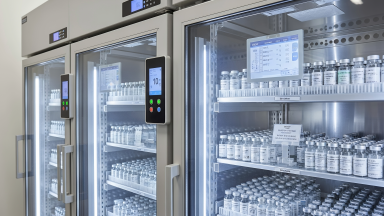
Pop quiz for clinical administrators across the Central Valley: How many copies of the key to your medication storage room currently exist?
If you said “two… one at the front desk and one with the charge nurse,” you answered what the policy says. The actual answer… the one nobody wants to verify… is probably closer to four or five, because copies were made when someone lost one, a traveling nurse needed temporary access, and the after-hours cleaning crew needed to get in there to mop the floor.
A physical key cannot tell you who used it, when, or how many times. It cannot tell you whether the person who used it was authorized. It cannot tell you whether the door was propped open after entry. And when your pharmacy director gets a call from the DEA or your compliance officer notices a controlled substance count discrepancy, the key will not testify on your behalf.
It is 2026. Your patients’ medications deserve better security than your house key.
Keys and Combination Locks Are Not Access Control
Healthcare facilities across the Central Valley… from the multi-location clinic groups in Fresno and Clovis to the community health centers in Tulare and Kings counties… rely on controlled substance storage as a daily operational function. Medications are dispensed, counted, documented, and reconciled. The systems for medication management are often quite sophisticated.
The systems for controlling physical access to where those medications are stored? Not so much:
- Physical keys with no audit trail. No record of who used the key, when, or for how long the door was open. Keys get copied, lost, and shared. When a discrepancy appears, the investigation starts with “who had the key?” and ends with “we’re not sure.”
- Combination locks that have not been changed since the clinic opened. The combination is known by every nurse, every float, and at least one former employee who left six months ago and was never removed from the mental list of people-who-know-the-code. Because there is no list. There is just institutional memory, which is a terrible security system.
- No camera coverage in the medication storage area. The hallway might have a camera. The storage room itself? Privacy concerns are cited, but there is no patient in the med room… just medications and the people accessing them. The privacy justification evaporates when you actually think about it.
- Manual sign-in sheets that are theoretically required and practically ignored. When’s the last time someone audited the medication room sign-in log and cross-referenced it against the controlled substance count? If the answer is “never,” you are not alone. If the answer is “last week, after we found a discrepancy,” you are in the majority.
Drug Diversion Is Not a Big-Hospital Problem. It Happens Everywhere.
Drug diversion… the unauthorized taking of controlled substances from a healthcare facility… is one of the most underreported and underdetected issues in healthcare. And it is not limited to large hospitals with inpatient pharmacies:
Community clinics are vulnerable. A Bakersfield urgent care center with a med room containing Schedule II substances and a key-only lock is, statistically, at higher risk than a hospital with an automated dispensing cabinet and badge-access pharmacy. The smaller the facility, the fewer the controls, and the easier it is to exploit gaps.
The DEA is paying attention to outpatient facilities. DEA registrant inspections are not just for hospitals and retail pharmacies. Clinics that maintain controlled substance inventories are subject to unannounced inspections. The DEA expects documented access controls, count reconciliations, and the ability to demonstrate who had access to inventory at any given time. A key and a sign-in sheet do not meet that standard in practice.
The financial exposure extends beyond the substances themselves. A confirmed diversion event at a healthcare facility triggers a cascade: DEA investigation, potential license action against the individual and the facility, mandatory reporting to the board of nursing or medical board, liability for patient safety issues if diverted medications were replaced with diluted or counterfeit substances, and… in Central California’s tight-knit healthcare community… reputational damage that affects recruiting and patient volume.
Your honest employees are the ones penalized by weak controls. When a controlled substance count comes up short and the investigation cannot determine who accessed the storage, every clinician who had potential access falls under suspicion. That is unfair to the nineteen people who did nothing wrong and demoralizing to a staff that is already stretched thin. Strong access controls do not just catch bad actors… they protect good ones.
Access Control That Answers Every Question Before It Gets Asked
PC Solutions replaces key-based medication storage access with Verkada’s cloud-managed access control… integrated with video… for healthcare facilities across the Central Valley.
1. Badge-Based Access With Complete Audit Trail Every medication room entry is logged: who, when, how long the door was open, and when it closed. The log is stored in the cloud, tamper-evident, and exportable. Your pharmacy director, compliance officer, and… if needed… the DEA can see exactly who entered the room and when. No more “we’re not sure.”
2. Video-Paired Access Events The nearest camera bookmarks footage for every access event. When the door opens, the system records not just the badge swipe but the visual confirmation of who walked through it. If a badge was shared, lost, or used by an unauthorized person, the video tells the story the badge swipe cannot.
3. Scheduled Access Restrictions Define when the medication room can be accessed and by whom. Night shift access limited to the charge nurse. Weekend access limited to the on-call provider. After-hours access triggers an alert to the clinic director. These rules are configured once and enforced automatically… no more relying on someone to remember to lock the door.
4. Instant Discrepancy Investigation When a controlled substance count comes up short, your pharmacy director does not need to interview six people and hope someone remembers something useful. They pull the access log for the relevant time period, review the paired video, and identify exactly who entered, when, and what they did. An investigation that used to take a week takes an afternoon.
5. Credential Management Across Multiple Clinics For a clinic group operating in Fresno, Visalia, and Bakersfield, access credentials are managed centrally. When a nurse transfers locations, their access updates immediately. When someone leaves the organization, their credential is revoked at every door… medication room, supply closet, server room… across every facility, instantly. No keys to collect. No combinations to change. No former employees on the “who-knows-the-code” list.
Your Medication Room Deserves Smarter Security Than Your Gym Locker
PC Solutions handles the full transition… from key-based access to cloud-managed credential systems… including door hardware, camera placement, network infrastructure, and ongoing managed support. We configure every deployment to meet DEA registrant requirements and HIPAA access control standards.
Schedule a medication security assessment →
Call 559.825.3200 or email sales@gopcsolutions.com